Why Your Vote Matters
Yes, Your Vote in St. Joe County
Michigan voters showed up in a big way for the August primary this year, and that turnout tells a story worth paying attention to as we head toward November.
Michigan
More Michigan voters cast a ballot in the August 2026 primary than in recent midterm cycles, and that surge turned out to be good news for Abdul el-Sayed, the Democratic nominee for Michigan's open U.S. Senate seat. el-Sayed's platform centers on getting money out of politics, putting money back in people's pockets, and passing Medicare for All. His primary win over U.S. Rep. Haley Stevens came down to a margin of about one percentage point, and it was a wave of new and infrequent voters, especially in communities that don't typically show up for a primary, that helped carry him there.
According to the Michigan Department of State's online voter data dashboard, 35% of the state's 7,359,866 registered voters cast a ballot in the August 2026 primary. That's a significant jump from the 27% turnout out of 8,130,200 eligible voters back in 2022. More people showing up to vote in a midterm primary is rare. More people showing up because they wanted a say in who represents them in the U.S. Senate? That's democracy doing exactly what it's supposed to do.
St. Joseph County
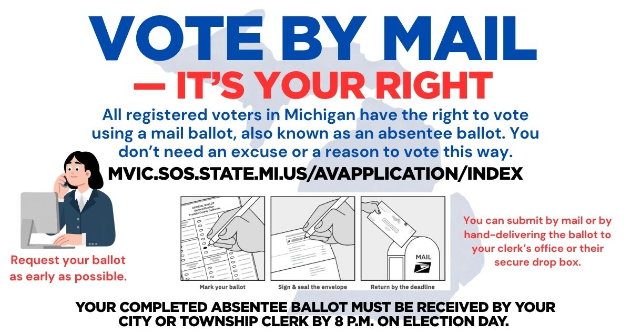
Here at home, St. Joseph County saw 27% of active registered voters turn out for the August 2026 primary. More than half of those ballots were cast absentee, which says something important on its own. Voters here are finding the method that works for them and using it. Absentee voting isn't a workaround. It's a legitimate, secure way to make sure your voice counts, and St. Joe County residents are proving that every election cycle.
That 27% figure puts St. Joseph County far below the statewide turnout rate, and that gap is worth sitting with for a minute. It's not a criticism. It's an opportunity. Every percentage point of turnout represents real people, our neighbors, who could be shaping decisions about schools, roads, health care, and who represents us in Lansing and Washington. The higher that number climbs, the more accurately our county's actual priorities show up in the results.
Rural Impact
There's a persistent idea that rural counties like ours don't carry much weight in statewide elections. Some analysts point to socioeconomic status and education levels as factors that can suppress turnout in areas like ours. Michigan media outlets have also documented real challenges facing rural communities: shrinking populations, aging local leadership, and a shortage of people willing to step into public office at all, let alone get engaged in bigger political fights. A recent Bridge Michigan investigation found that more than three-quarters of Michigan townships and villages struggle to find people willing to fill elected or appointed positions, and many races go uncontested simply because no one files to run. That's not a St. Joseph County problem alone. It's a rural Michigan problem, and it's a warning sign about what happens when people opt out.
But here's the thing: rural voters aren't a footnote in Michigan elections. They're often the deciding factor. Rural turnout was credited with delivering Michigan to Donald Trump in 2024, when counties with the smallest populations saw some of the largest increases in voter turnout in the state, even as turnout in Michigan's largest counties barely moved. That's not a partisan observation. It's a math lesson. When rural voters mobilize, they can swing a statewide race, regardless of which direction they swing it.
That same math applies here. St. Joseph County voters can absolutely make a difference in the outcome of the November 3rd election, whether that's the U.S. Senate race, the race for governor, or the local races that decide who runs our townships, our schools, and our county government. The 2026 primary already showed what's possible when turnout rises. Imagine what a strong general election turnout could mean for St. Joseph County's voice in Lansing and Washington.
What You Can Do
Voting is the most direct way to have a say in what happens next, but it's not the only one. If you've read this far and you're frustrated that so few people want to step up and lead in rural communities, consider this an invitation. Local boards, township offices, and school boards all need people willing to serve. You don't have to run for the U.S. Senate to make a difference. Sometimes the biggest impact starts with showing up to a township meeting or agreeing to serve on a board nobody else wants to join.
In the meantime, mark your calendar for November 3rd. Make a plan for how you'll vote, whether that's absentee, early, or in person. Talk to your neighbors about the election. Turnout doesn't happen by accident. It happens because people decide their vote matters enough to act on it.
St. Joseph County has already shown it can move the needle. Let's keep that momentum going into November.
Additional perspectives
Two podcast episodes also speak to how important every vote is, and how to help increase voter turnout.
Sources/Inspiration: