Keeping the Lights On: How Rising Utility Profits Hit Home in St. Joseph County
A national report on soaring utility profits has an unmistakable local chapter. Families in Three Rivers, Sturgis, and Centreville are already feeling it.
A new analysis by the Energy and Policy Institute, a utility watchdog group, found that investor-owned utility profits have soared as consumer utility bills have skyrocketed in recent years. Last year, state-regulated, investor-owned electric utilities kept about 15 cents of every dollar they collected as profit. What does that mean for you? A customer paying a $200 monthly electric bill sent roughly $30 straight to corporate shareholders.
For Michigan specifically, the numbers are worse than the national norm. A DTE Energy customer with a $150 monthly electric bill pays an estimated 16.7% of their bill (about $25) in utility profits, while Consumers Energy customers pay 13.9%. Both Michigan utilities rank in the top half nationally for the share of customer bills going toward profits.
Here in St. Joseph County, Consumers Energy is the dominant provider, serving households from Sturgis to Colon to White Pigeon. The average residential electric bill in St. Joseph County is currently about $147 per month, and that number is heading up. The Michigan Public Service Commission approved a $276 million, or 6.1%, rate hike for Consumers Energy effective May 1, 2026. For a typical residential customer using about 500 kilowatt hours a month, that means an increase of $6.46 per month. CBS News
That may not sound like much in isolation. But it is the latest in a long line of increases. Over the past five years, Consumers Energy customers have seen electric bills rise by an estimated 12% to 18%. A typical monthly bill that hovered around $100 in 2020 is now commonly landing between $120 and $130. And since 2020, the MPSC has approved nearly $800 million in annual revenue increases for Consumers Energy, with the company eligible to file its next rate hike request as early as June 2026.
What It Means for a Typical Family Here
The median household income in St. Joseph County is about $66,425. That’s roughly 80% of the national median, and the county is home to a significant share of manufacturing workers, farm families, and retirees on fixed incomes. Energy costs that feel manageable on a higher income can strain a household budget considerably at that income level.
Using current figures, a family in Three Rivers paying the county average of $147/month in electricity is already spending about $1,764 per year just to keep the lights and heat running. Add natural gas, which most rural southwest Michigan homes rely on for heating, total annual energy costs for a typical household can approach $2,500 or more.
Here's what additional rate increases could look like for a St. Joseph County household:
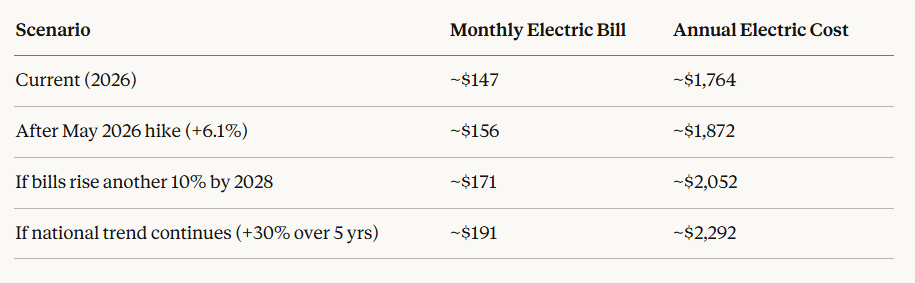
That last scenario isn't far-fetched. Residential energy bills nationally increased 30% between 2021 and 2025, and Michigan households are projected to pay an additional $160 per year on their energy bills by 2030 due to federal policy changes passed last year.
The Burden Falls Hardest on Rural Households
Rural households in southwest Michigan face compounding pressures. Many homes are older and less energy efficient, increasing consumption. Propane or heating oil dependence, common among the township homes outside Sturgis and Three Rivers, adds another unpredictable cost layer on top of electric bills. And unlike urban residents, rural families generally have no transit alternatives to offset transportation costs when money gets tight.
Michigan Attorney General Dana Nessel called the pattern a "never-ending cycle" of rate hikes, saying the process "continues to place the burden on ratepayers and demands greater accountability."
The state does offer help through the Michigan Energy Assistance Program (MEAP), which provided assistance to more than 56,000 income-eligible customers last year (State of Michigan). Although with an estimated 150,000 eligible households statewide, many who qualify still aren't enrolled.
The watchdog report's findings make clear that these aren't just market forces at work — they are policy choices. State regulators set the profit margins utilities are allowed to earn, and advocates are increasingly calling for those margins to be reduced. Consumer advocates are pushing for lower returns on equity and more ratepayer representation to reduce the utility bill burden on Michigan families. Planet Detroit
For families in Constantine, Mendon, White Pigeon, Centreville, and across the rural stretches of St. Joe County, the question isn't abstract. It's whether the lights stay on, and what else gets cut to make that happen.
Want more news like this in your inbox?
Data sources: Energy and Policy Institute, Michigan Public Service Commission, EnergySage, U.S. Census Bureau ACS 2024, Center for American Progress, Michigan Attorney General's Office.